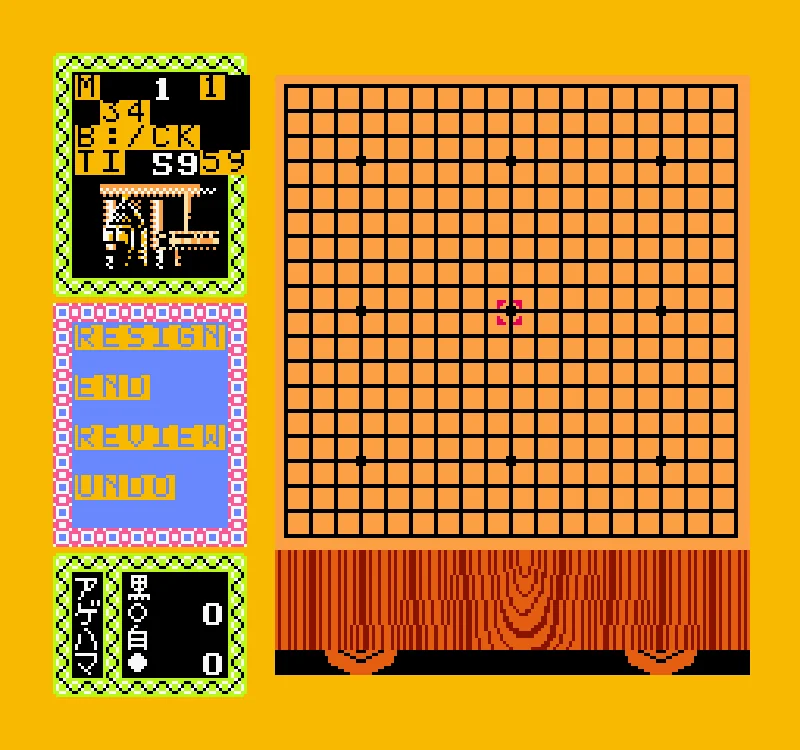
Machine translation is not great. People rightfully complain about slop translations of story-based games but I frequently need to play Japanese games that no human translator is ever going to waste their time with. I usually need utilitarian menu translations that just get me into the game. That means holding a phone with Google Translate up to my display or using Retroarch’s AI service to automate taking and translating screenshots. It’s not great.
I’m looking into historical Igo games and AI is magic now, so I just pointed LLMs at a ROM file of Famicom Igo Nyuumon and said “Translate this to English, make no mistakes.”
The LLMs made numerous scripts to extract and analyze the CHR data from the ROM and decided a 2000-line Python script to edit and build the English ROM was the way to do this. All the LLMs ran an emulator and repeatedly compared screenshots of the Japanese version to their English work.
# Shift the right-hand value box one cell left (border $23 -> $22) so
# five-letter values (HUMAN / WHITE) sit entirely inside one attribute
# block.  At the old x=24..28 position the last letter fell into the
# next block and received the border palette.
for yy, label, o1, o2 in ((15, 'OPPONENT', 'CPU', 'HUMAN'),
                           (17, 'COLOR', 'BLACK', 'WHITE'),
                           (19, 'HANDICAP', 'NO', 'YES')):
    s7put(3, yy, label); s7put(17, yy, o1); s7put(23, yy, o2)
I usually use Deepseek Flash and GLM 5.3 Flash but both did worse than I expected. On a first pass they messily translated a random third of the text in the game, typically leaving untranslated text, graphical glitches, and poor color choices.
On screens with complex text, the flash models often just dumped black and white text disregarding graphics and layout.
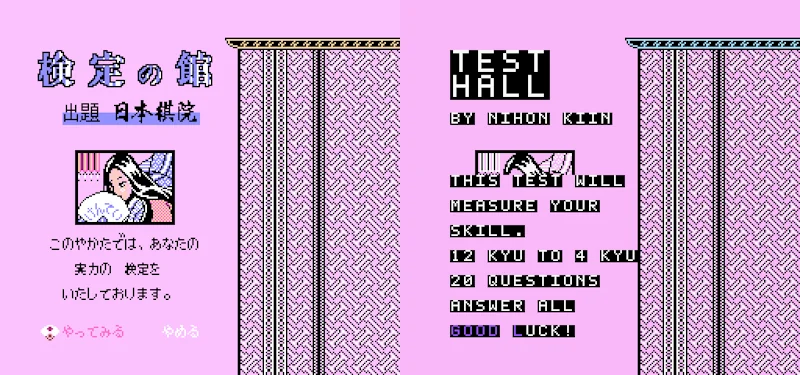
Both were capable of good results but it was on a painstaking issue-by-issue basis. They sometimes took two steps forward, two steps backwards introducing new problems. Kimi K3.1 Pro had a chain of thought that suggested better understanding than the flash models and quickly found graphical glitches and untranslated text repeatedly missed by the other two.
Kimi, unprompted, changed the wording of phrases to better fit screen space. For example BLACK TO PLAY awkwardly spilled onto a box border. Kimi changed it to the more concise but nonidiomatic BLACK PLAYS. It’s a Go game. This isn’t a big deal, but when translating dialogue it will make questionable choices that bring out the machine translation police.
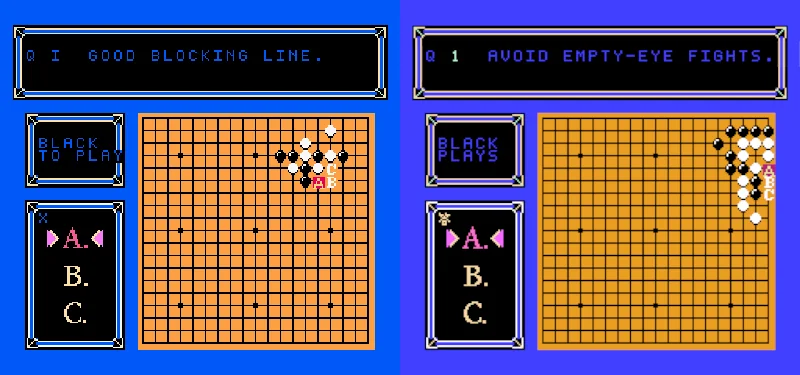
Twice, the LLM removed screens from the game (!!) and this is not a big game. First it erroneously bypassed an entire menu of lessons, shortcutting directly to a submenu. The second time it intentionally combined a frankly unnecessary Start/Back menu and the instructions screen that came after it. This made the UI more concise and better, but I don’t want the LLM to try to make the game better!
The LLM also decided at some point to remove a minor section of the game (the Select menu) because it was too much translation work for a single prompt. If you didn’t read the output and realize this, it would be easy to not remember to put it back.
I gave up on the dream of proving how easy this project would be with open weights and pointed an evil LLM (Gemini 4 Neon) at it to fix the random untranslated text and remaining glitches.
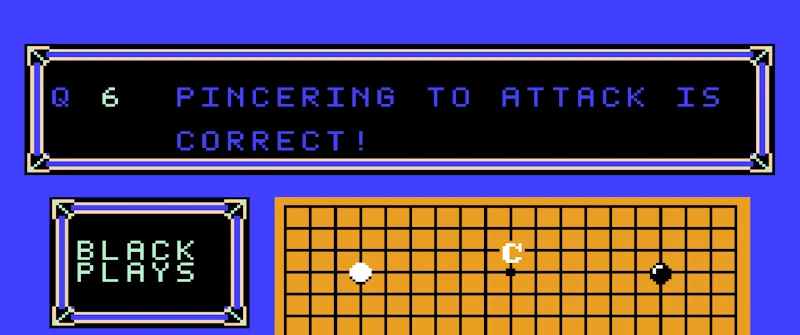 It’s awkward and full of Go jargon, but Google’s translation was way less literal
As you’d expect these days it thoroughly one-shot that, making individual tests for almost every screen and interaction in the game. It also found and fixed numerous mistranslations for all sorts of reasons (period slang, truncation errors, non-idiomatic phrasing, over-literal translations, misunderstanding Go rules/terms).
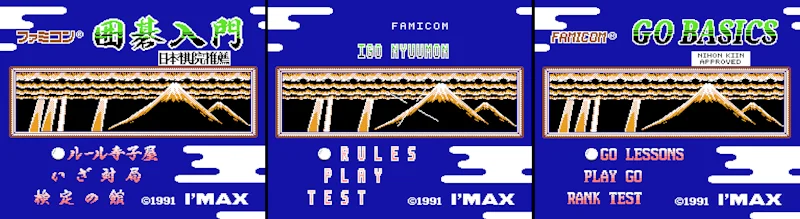 Left: Japanese Title, Middle: Open-weight Title, Right: Google Title
Google also made an incredible English title screen in one shot. The screen the open-weight models collectively made in the center took dozens of prompts, negotiating, bargaining, and technical explanations for why it wasn’t feasible to make big English title text and that was by far my best result.
Check out the game here: famicom-igo-nyuumon-translation
This certainly worked well enough for me to play Famicom Igo Nyuumon (Wow, it’s a Go game!). But it took way more babysitting than I expected so the LLM wouldn’t sabotage the game. I hoped this would be an easy task I can move to a local workflow, but that’s definitely not the case right now. I can imagine 1000 ways an LLM could mess up an RPG that wouldn’t be nearly as easy to spot as this simple board game.
In my brief experience with LLM reverse engineering projects even powerful open weight models really struggle compared to frontier models. This end result might be possible with Deepseek, but it would be slow and painful. But last year I wouldn’t have even considered this feasible and 10 years later here in November 2026, this is just obviously something AI can do.
As usual, this is the worst it will ever be.